Paused project · notes reviewed 2026-11-14. This records the work, not live cluster health.
ADR-0001: Pull-based backup and portable recovery
This is the proposal for recovering when the cluster or the house is unavailable. It records the design and the decisions needed before implementation.
Where this stands #
Notes reviewed against the repository on 14 November 2026. The proposal below has not recorded a completed implementation or independent restore evidence. It is listed with paused work, rather than presented as an active rollout.
| Stage | Recorded position |
|---|---|
| Design and failure scenarios | Proposed in this decision record |
| Garage NAS and read-only pull transport | Decisions outstanding |
| Integrity checks and restore-aware retention | Acceptance criteria defined below; completion not recorded |
| Encrypted cold copy and portable restore | Provider, cost and recovery evidence outstanding |
Next: settle the NAS, transport, retention and spending decisions below before calling this an implementation project. The retired R2 backup history explains the previous approach and the existing recovery archive.
Original decision record #
- Status: Proposed
- Date: 2026-07-23
- Decision owner: Dan Webb
Context #
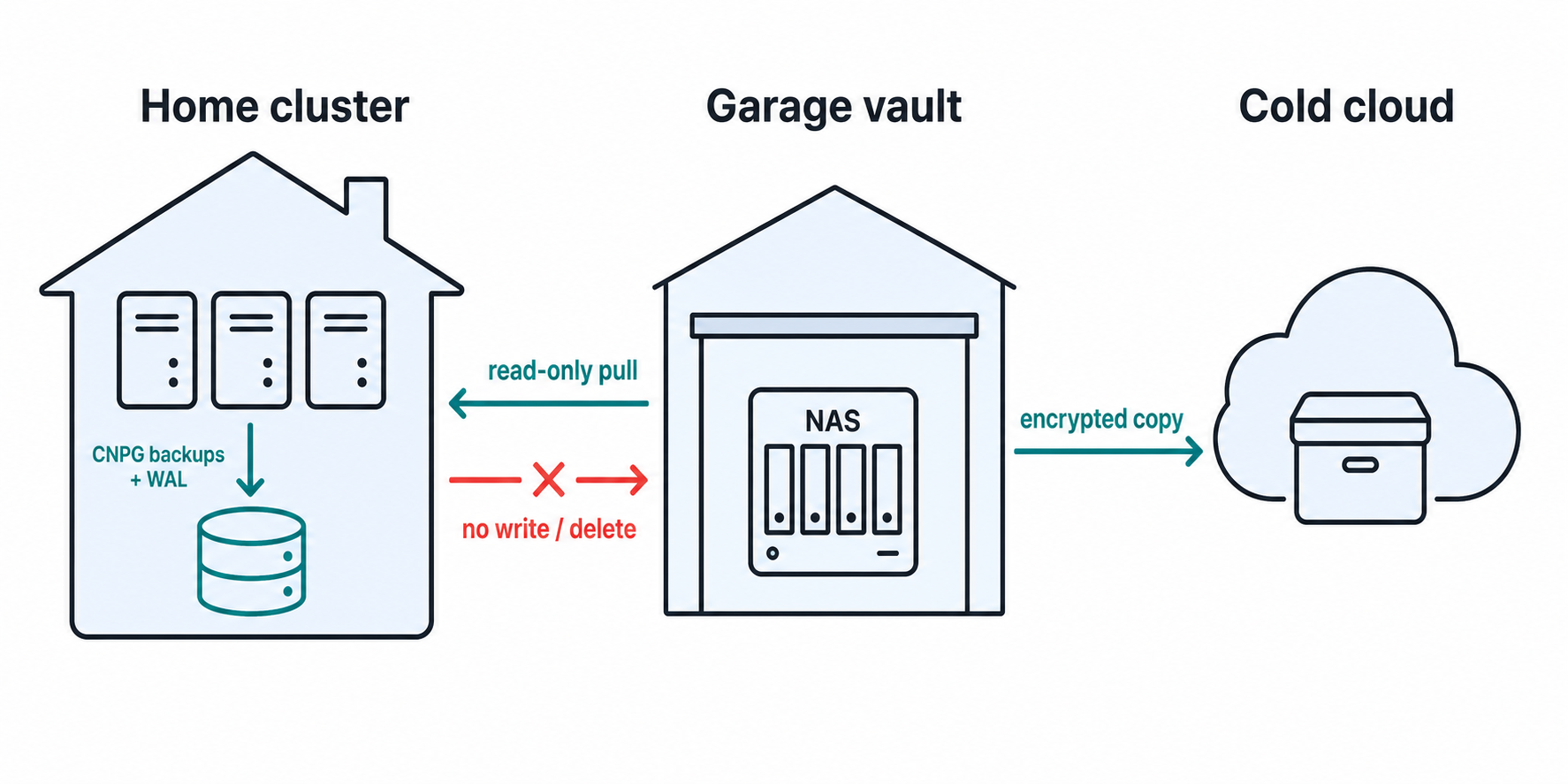
CloudNativePG database backups and WAL archives are currently written to per-application buckets in the in-cluster RustFS S3-compatible object store. The current design protects against an individual database or volume failure, but it does not independently protect the backup archive from a cluster-wide compromise or loss of the house.
Cloudflare R2 was previously used for backups, but its ongoing storage cost was not proportionate to the required recovery posture. A detached garage roughly 35 metres from the house is available for a separate backup appliance, using spare HDDs. It is a separate building and therefore a strong near-site recovery location, but it is not a geographically independent recovery site.
The desired outcome is to preserve recoverable data through a cluster, primary-storage, or house loss without paying for continuously hot cloud storage. This is portable recovery, not hot disaster recovery: if the property is unavailable, services will be restored to replacement or temporary compute later.
Decision #
Adopt a pull-based, layered backup design.
CNPG and workload backups -> in-cluster RustFS
Garage vault pulls a read-only copy from RustFS
Garage vault makes a periodic encrypted copy to cold cloud storage
The initial implementation priority is CloudNativePG Barman base backups and WAL archives. Workload volumes, bootstrap material, and recovery documentation must join the strategy before it is fully implemented.
Security and ownership boundaries #
- The garage vault initiates every transfer. The home cluster has no credentials, route, or administrative interface that can write to or delete from the garage repository.
- The garage uses a RustFS identity limited to listing and reading relevant backup buckets. Separate target credentials write the garage repository.
- Replication is additive: upstream deletes, delete markers, and arbitrary overwrites must not remove retained garage history.
- Retention and garbage collection are controlled by the garage with a separate protected credential. The routine copy identity cannot remove retained recovery points.
- The garage repository is encrypted at rest. Encryption-key recovery material is stored outside the property and cannot depend on the cluster.
- The garage exposes no generally reachable management service to the home cluster. Required connectivity is initiated by the garage and limited to backup traffic.
Retention and recoverability #
The garage vault owns its day-based retention lifecycle, but it must be Barman/PITR-aware. A base backup cannot expire independently of WAL needed to recover it. Retention automation must preserve a complete recoverable backup generation and its required WAL/history files, rather than applying a generic object-age deletion rule.
Exact local and cloud retention durations are deferred until implementation measures real archive volume and cold-copy cost. The policy must state the oldest restore point, PITR window, immutable-history interval, and expected RPO for every protected data class. Until then, conservative retention is safer than automated pruning.
Property-loss recovery #
The garage is a near-site backup vault, not an alternate compute site. It can preserve data after house-local failures, but cannot restore services when the property is unavailable.
The periodic encrypted cold-cloud copy is the off-property last-resort copy. It must contain enough data and recovery material to provision temporary or replacement compute.
Required recovery material includes:
- the GitOps repository and bootstrap instructions;
- encrypted configuration and the means to recover its encryption keys;
- access to the secrets-manager account and its recovery process; and
- a tested procedure to provision fresh compute and restore a CNPG cluster from the copied Barman archive.
No continuously running remote cluster is required. The accepted trade-off is a recovery time measured in days, rather than immediate service continuity, after loss of the property.
Consequences #
Positive #
- A compromised cluster cannot directly erase garage recovery history.
-
The garage provides faster local recovery while being physically separate from the house.
- A low-frequency cold-cloud copy protects against property loss without the cost of a continuously hot cloud archive.
- Retention becomes a policy of the backup vault, not an accidental effect of source-bucket cleanup.
Negative and accepted trade-offs #
- The NAS needs supported software, redundant disks, monitoring, power protection, encryption, and maintenance.
- The house and garage share some risks; cold cloud storage remains necessary.
- Pulls delay replication by their schedule and need restricted connectivity.
- This design does not provide immediate compute after property loss.
Rejected alternatives #
Cluster-pushed backups to the garage #
Rejected because a cluster compromise would expose the garage write/delete credential and make the independent copy vulnerable to the same incident.
Destructive mirroring from RustFS #
Rejected because source deletion—accidental or malicious—would remove the very history needed for recovery.
Cloud-only hot backups #
Rejected because the earlier Cloudflare R2 operating cost was not justified by the required recovery time. Cold cloud storage remains as the smaller, property-loss copy.
Garage-only backups #
Rejected because a separate building on the same property is not sufficient protection from total property loss.
Immediate multi-site/high-availability disaster recovery #
Rejected for now because it adds ongoing compute, operational complexity, and runbook burden beyond the portable-recovery objective.
Implementation and acceptance criteria #
- Rebuild the old NAS with supported software, encrypted redundant storage, disk-health monitoring, and power protection.
- Create separate RustFS read-only identities for the garage puller and separate target/retention identities that do not exist in Kubernetes.
-
Implement additive, integrity-checked copies of CNPG Barman archives to the garage, alerting on a missed pull or verification failure.
- Add PITR-aware garage retention and an immutable-history interval. Prove pruning retains a complete restore chain before enabling it.
- Copy selected garage recovery points, encrypted, to a provider-neutral cold cloud target on a costed schedule.
- Prove a full restore and a Point-in-Time Recovery from the garage copy.
- Prove a portable restore from the cold-cloud copy to fresh temporary or replacement compute, including bootstrap and secrets recovery.
The strategy is operational only when steps 6 and 7 have succeeding evidence and the tested RPO/RTO are documented.
Open decisions #
- DSM is the current NAS operating system. Confirm its model/release support, storage layout, garage placement and pull transport before enrolment.
- Exact local and cold-cloud retention schedules after measuring archive size.
- Cold-storage provider and monthly spending ceiling.
- Encryption-key escrow and secrets-manager recovery procedure.
- Temporary/replacement compute provider or physical destination for a property-loss event.
References #
- CloudNativePG Barman Cloud Plugin documentation: https://cloudnative-pg.io/plugin-barman-cloud/docs/
- CISA ransomware guidance on maintaining separate, segmented, and tested backups: https://www.cisa.gov/stopransomware/ransomware-guide